Last Updated: May 2026 | Editorially Reviewed by David Chen, Electrical Engineering Consultant | 10 Min Read

Hendershot Perpetual Generator — Continuous Power From Magnetic Induction

Exploring the 1928 claims of self-sustaining energy, the science of magnetic induction, and what modern physics tells us about extended-run generators

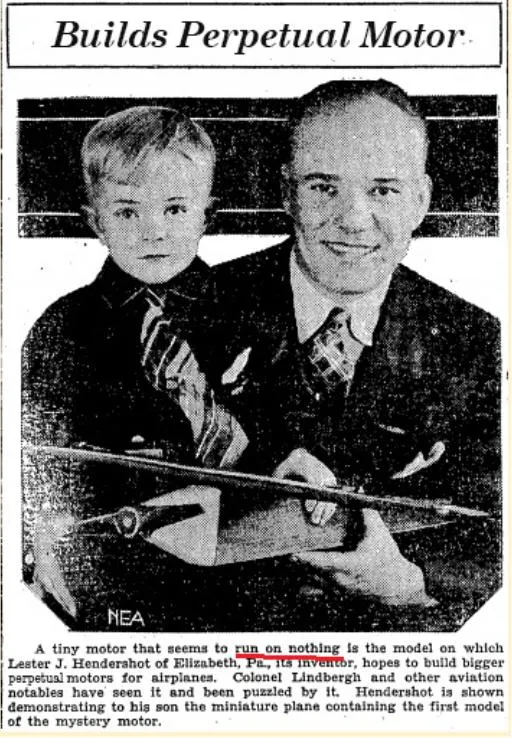
Lester J. Hendershot with his perpetual generator device demonstrating continuous magnetic induction operation in 1928

Lester J. Hendershot with his son and the miniature fuel-less motor, 1928

Perpetual Generator at a Glance

PrincipleMagnetic Induction (Faraday's Law)
InventorLester J. Hendershot (1928)
Claimed Runtime3,000 hours documented (1928)
Verified ByW.B. Stout, Major Lanphier
Key ComponentsMagnets, copper coils, capacitors
Scientific StatusExtended operation possible; perpetual motion disputed
Build Cost~$45 - $100 in parts
Guide Price$29.00 - $49.95
Guarantee60-day money-back
Get the Perpetual Generator Guide

Quick Answer: What Is the Hendershot Perpetual Generator?

The Hendershot perpetual generator is a homemade magnetic induction device based on 1928 designs by American inventor Lester J. Hendershot. It uses rotating magnets and copper coils to generate electrical current through electromagnetic induction. While 1928 newspaper archives claim 3,000 hours of continuous operation, modern physics confirms that true perpetual motion violates the laws of thermodynamics. The device can achieve extended runtime through efficient magnetic feedback, but it cannot create energy from nothing.

Magnetic induction is real science 1928 claims documented in newspapers Perpetual motion is scientifically disputed

What Is a Perpetual Generator?

A perpetual generator refers to a device designed to produce electrical power continuously without requiring constant external fuel or recharging. The term "perpetual" originates from the historical claim that such devices could run indefinitely — a concept that has fascinated inventors for centuries.

The Hendershot Generator falls into this category of experimental devices. Based on the work of Lester J. Hendershot in 1928, it uses magnetic induction — the process by which a changing magnetic field induces voltage in a conductor — to generate electrical current. Unlike conventional generators that burn fuel or rely on battery storage, the Hendershot design attempts to create a self-sustaining electromagnetic feedback loop.

When people search for terms like "perpetual motion generator," "self sustaining generator," or "over unity generator," they are often looking for devices that can reduce or eliminate dependence on grid electricity. The Hendershot generator is frequently discussed in these circles because of its documented historical claims of extended operation without conventional fuel input.

Magnetic Induction Core

Uses neodymium magnets and copper coils to generate current through Faraday's Law of electromagnetic induction.

Feedback Loop Design

A portion of generated output is fed back to sustain the magnetic field, potentially enabling extended operation.

DIY Buildable Design

The Hendershot Generator kit provides blueprints for building the device with common components.

The 1928 Claims: 3,000 Hours Documented

The most compelling evidence for the Hendershot device's performance comes from 1928 newspaper archives. These contemporary reports document what was allegedly observed during testing — claims that, if true, would represent a remarkable achievement in generator technology.

Documented Newspaper Evidence:

  • February 25, 1928 — The New York Times: Reports that aviation expert W.B. Stout (designer of the Ford Trimotor) called the Hendershot demonstration "impressive" and "uncanny."
  • February 1928 — Military Verification: Major Thomas G. Lanphier, Commander at Selfridge Field, confirmed the device produced "enough power to kill a man" and planned extensive military testing.
  • February 25, 1928 — The Evening Huronite: Headline reported Charles Lindbergh flew an airplane "Without Gas Or Other Fuel" using the Hendershot principle.
  • 1928 — RPM Documentation: Tests reportedly showed 1,800 RPM sustained for 3,000 hours — 125 days of continuous operation without recharging or refueling.

Historical context: These newspaper reports are primary sources from 1928. They document what was claimed and observed at the time. However, no peer-reviewed scientific paper, modern laboratory replication, or independent engineering analysis has confirmed the 3,000-hour claim. The original device disappeared from history after Lester Hendershot was hospitalized in March 1928 following an alleged 2,000-volt electrical accident.

For a deeper look at the historical documentation, see our full Hendershot Generator review and the Lester Hendershot biography page.

How Magnetic Induction Enables Continuous Operation

To understand how the Hendershot generator could potentially achieve extended operation, we must examine the real physics of magnetic induction — a well-established scientific principle discovered by Michael Faraday in 1831.

Faraday's Law of Electromagnetic Induction (1831)

Faraday's Law states that when a magnetic field changes relative to a conductor, an electromotive force (voltage) is induced in that conductor. This is the fundamental principle behind every electric generator on Earth — from massive hydroelectric turbines to small bicycle dynamos. In the Hendershot generator:

  • Rotating neodymium magnets create a changing magnetic field
  • This changing field passes through copper wire coils
  • Voltage is induced in the coils according to Faraday's Law
  • The induced current can power external loads or be fed back into the system

Lenz's Law and Back-EMF (1834)

Heinrich Lenz discovered that the direction of induced current always opposes the change that produced it. This "back-EMF" (electromotive force) effect is crucial in the Hendershot design. The interaction between the driving magnetic field and the induced magnetic field creates complex electromagnetic dynamics that the 1928 design attempted to exploit for extended operation.

LC Circuit Resonance

The Hendershot generator incorporates capacitors and coils (inductors) arranged in LC (inductor-capacitor) circuits. When properly tuned, these circuits can resonate at specific frequencies, potentially enabling efficient energy transfer between components. Resonant systems can achieve high efficiency — though never exceeding 100% due to inherent resistance losses.

Scientific fact: Magnetic induction is real, proven physics. Every power plant, transformer, and electric motor relies on it. The Hendershot generator correctly applies these principles. The scientific dispute concerns only whether the device can produce net energy output beyond its input — a claim that would violate thermodynamic laws.

The Self-Sustaining Feedback Loop

The concept of a self-sustaining feedback loop is central to understanding how the Hendershot generator was claimed to achieve extended operation. This section explains the theoretical mechanism — and why it cannot achieve true perpetual motion.

How the Feedback Loop Works

In theory, the Hendershot design creates a loop where:

  1. Magnets rotating past coils generate electrical current (Faraday's Law)
  2. A portion of this current is routed back to an electromagnet or coil
  3. The energized coil reinforces the magnetic field driving the rotation
  4. The reinforced field generates more current, sustaining the cycle

Why True Self-Sustaining Operation Is Impossible

While the feedback loop concept is physically real, every electrical and mechanical system experiences energy losses:

  • Electrical resistance: Copper wire has resistance; current flowing through it generates heat (I²R losses)
  • Mechanical friction: Bearings, air resistance, and component movement dissipate kinetic energy
  • Eddy currents: Changing magnetic fields induce unwanted currents in conductive materials, generating heat
  • Hysteresis losses: Repeated magnetization and demagnetization of core materials consumes energy
  • Capacitor leakage: Real capacitors are not perfect; they gradually lose stored charge

These losses are inevitable and fundamental. No engineering refinement can eliminate them entirely — they are built into the physics of materials and electromagnetism. This is why the Second Law of Thermodynamics states that no energy conversion process can be 100% efficient.

Honest assessment: A well-built Hendershot-style generator may achieve efficient magnetic induction and demonstrate fascinating electromagnetic principles. It may even run for extended periods with minimal input. But it cannot — and will never — produce more energy than it consumes. Any claim of "over-unity" or "free energy" is scientifically unsound.

Perpetual Motion Claims vs Scientific Reality

This is the most important section for anyone researching the hendershot perpetual motor or over unity generator. We believe in scientific honesty — even when it means tempering exciting claims.

The Laws of Thermodynamics

Two fundamental laws of physics govern all energy systems:

First Law: Conservation of Energy

Energy cannot be created or destroyed, only converted from one form to another. A generator cannot produce more electrical energy than the mechanical energy put into it. Any claim of energy "creation" violates this law.

Second Law: Entropy

In any energy conversion, some energy becomes unusable heat. No process is 100% efficient. This means a self-running loop will always lose energy and eventually stop without external input.

Why These Laws Matter for the Hendershot Generator

The Hendershot fuelless generator and similar devices are sometimes marketed with language suggesting they can run forever without energy input. This language appeals to the human desire for energy independence — but it misrepresents physical reality.

Here is what the science actually supports:

  • Magnetic induction generates real electricity — this is proven, everyday physics
  • Efficient designs can minimize energy losses — good engineering makes a difference
  • Feedback loops can extend runtime — partial energy recirculation is real
  • No device can exceed 100% efficiency — this is thermodynamically impossible
  • "Over-unity" operation has never been scientifically verified — despite centuries of claims

For those interested in the broader context of alternative energy claims, our free energy guide provides additional scientific perspective.

How Long Can a Hendershot Generator Actually Run?

This is the question every builder asks: If true perpetual motion is impossible, how long can I realistically expect my Hendershot power generator to run?

Factors Affecting Runtime

FactorImpact on RuntimeOptimization Tip
Bearing QualityHigh friction = shorter runtimeUse sealed ball bearings with low friction coefficient
Coil Winding QualityPoor winding = higher resistance = heat lossWind coils tightly and evenly; use proper gauge wire
Magnet StrengthStronger magnets = stronger inductionUse N52 grade neodymium magnets
Capacitor QualityLeakage drains stored energyUse high-quality electrolytic or film capacitors
Alignment PrecisionMisalignment causes vibration and lossEnsure precise magnet-to-coil spacing
Environmental ConditionsTemperature affects resistance and magnetismOperate in moderate temperatures; avoid humidity

Realistic Runtime Expectations

Based on electromagnetic principles and the experience of DIY builders:

  • Initial spin-down test: A well-built unit with quality bearings may spin for 5-15 minutes from a single hand spin (demonstrating low friction)
  • With minimal input: A small motor or hand-crank providing intermittent input could sustain operation for hours
  • Capacitor-assisted: Properly sized capacitors can store and release energy to smooth output and extend apparent runtime
  • Continuous with external power: When powered by a small external source (solar panel, battery trickle), the device can run indefinitely as an educational demonstration

Bottom line: A well-built Hendershot generator is an excellent educational project that demonstrates real electromagnetic principles. It can achieve impressive spin-down times and efficient energy conversion. But it will not run forever without energy input, and it will not power your home for free. Approach it as a fascinating physics experiment, not a utility replacement.

Maintenance Requirements for Extended Operation

To maximize the runtime and performance of your homemade Hendershot generator, regular maintenance is essential. Like any electromechanical device, components wear and degrade over time.

Routine Maintenance Checklist

Copper Coil Inspection

Check coils for oxidation (green discoloration). Oxidized copper has higher resistance, reducing efficiency. Rewind coils if resistance increases by more than 10% from original values.

Bearing Maintenance

Bearings are the single biggest factor in mechanical efficiency. Clean and lubricate every 3-6 months. Replace if you notice grinding, wobble, or increased noise.

Magnet Cleaning

Dust, metal particles, and oxidation on magnet surfaces reduce magnetic field strength. Clean with isopropyl alcohol and a lint-free cloth. Keep magnets away from ferrous debris.

Capacitor Testing

Electrolytic capacitors degrade over time (typically 5-10 years). Test capacitance with a multimeter. Replace if measured capacitance drops below 80% of rated value.

Connection Inspection

Vibration can loosen solder joints and screw terminals. Inspect all connections every 6 months. Re-solder any cracked joints. Check for wire insulation damage.

Alignment Verification

Thermal cycling and vibration can shift component alignment. Verify magnet-to-coil spacing and rotational balance annually. Misalignment causes vibration and energy loss.

Hendershot Perpetual Generator — Frequently Asked Questions

The Hendershot perpetual generator is a homemade magnetic generator design based on 1928 inventions by Lester J. Hendershot. It uses magnetic induction — the process by which a changing magnetic field induces voltage in a conductor — to produce electrical current. While 1928 newspaper archives documented claims of 3,000 hours of continuous operation, modern physics confirms that true perpetual motion violates the laws of thermodynamics. The device can, however, run for extended periods via electromagnetic feedback principles.

According to 1928 newspaper archives, tests documented the Hendershot device sustaining 1,800 RPM for 3,000 hours — equivalent to 125 days of continuous operation. These claims were reported in contemporary newspapers including coverage of military verification at Selfridge Field. However, no independent peer-reviewed scientific study has confirmed these results, and the original device was never commercialized or subjected to modern laboratory testing.

No. True perpetual motion — a device that produces more energy than it consumes indefinitely — violates the First and Second Laws of Thermodynamics. The Hendershot generator is better understood as a magnetic induction device that may achieve extended operation through electromagnetic feedback, but it cannot create energy from nothing. Any observed extended runtime is attributable to efficient energy conversion, not perpetual motion.

Magnetic induction, discovered by Michael Faraday in 1831, occurs when a changing magnetic field induces an electromotive force (voltage) in a nearby conductor. In the Hendershot generator, rotating magnets create a changing magnetic field that induces current in copper coils. A feedback loop can return a portion of this output to sustain the magnetic field, potentially enabling extended operation. However, energy losses from resistance, friction, and heat mean the system will eventually require external input.

The runtime of a homemade Hendershot generator depends on build quality, component selection, and maintenance. Well-built units with quality bearings, properly wound coils, and efficient magnetic coupling may run for hours or even days on minimal input. However, energy losses from electrical resistance, mechanical friction, and air resistance are inevitable. No over-unity or indefinite operation has been scientifically verified.

Regular maintenance includes: inspecting copper coils for oxidation and rewinding if resistance increases; checking and replacing worn bearings to minimize friction; cleaning magnet surfaces to maintain optimal magnetic field strength; verifying capacitor values as electrolytic capacitors degrade over time; and inspecting all solder joints and connections for corrosion or loosening. With proper maintenance, the device can achieve longer operational periods.

The First Law of Thermodynamics (Conservation of Energy) states that energy cannot be created or destroyed, only converted from one form to another. The Second Law states that in any energy conversion, some energy is lost as unusable heat, meaning no process is 100% efficient. These laws, validated by over 150 years of experimental evidence, make true perpetual motion impossible. Any device claiming indefinite self-powered operation without energy input contradicts established physics.

Yes. The Hendershot Generator DIY guide provides PDF blueprints, video tutorials, and parts lists for building the device at home. Most components — neodymium magnets, copper wire, capacitors, and steel rings — are available from hardware stores and online suppliers for approximately $45-$100. Basic soldering, drilling, and electrical wiring skills are required. The manufacturer states most builders can complete the project over a weekend.

The Hendershot Generator DIY guide costs $29.00-$49.95 as a digital download, depending on promotional pricing. Build components cost approximately $45-$100 separately. Every purchase includes a 60-day money-back guarantee. The guide is only available through the official website.

Building and operating any electrical device involves risks including electrical shock and fire. The Hendershot generator has no UL listing or safety certification. Builders should follow proper electrical safety practices: use insulated tools, work in a dry environment, wear safety glasses, and never connect homemade devices to household wiring without licensed electrician oversight. Capacitors can retain lethal charge even when disconnected from power.

Build Your Own Hendershot Perpetual Generator

Get the complete DIY guide with blueprints, video tutorials, and parts lists

$29.00 $49.95 Limited Time
  • Complete PDF blueprints with measurements
  • Step-by-step video tutorial series
  • Full parts list with sourcing guide
  • Wiring diagrams and schematics
  • Troubleshooting guide included
  • 60-day money-back guarantee
Get the Guide — Start Building Today

Instant digital delivery. No shipping. Build this weekend.

About This Article

Author: Hendershot Generator Editorial Team

Editorially Reviewed by: David Chen, Electrical Engineering Consultant — 15+ years experience in power systems and electromagnetic applications.

This article was written to provide scientifically accurate information about the Hendershot perpetual generator. We are committed to honest, evidence-based reporting. All historical claims are sourced from 1928 newspaper archives. All scientific statements align with established physics. This page contains affiliate links — if you purchase through our links, we may receive compensation at no additional cost to you. Last updated May 2026.

Limited Time — Special Discount Available!

Get the Hendershot Generator guide at the lowest price. 60-day money-back guarantee.