Last Updated: May 2026 | Editorially Reviewed by David Chen, Electrical Engineering Consultant | 10 Min Read

Hendershot Fuelless Generator Plans — Build a Generator With No Fuel Costs

Discover how the 1928 Hendershot device ran without gasoline, diesel, or any fuel — and how you can build your own

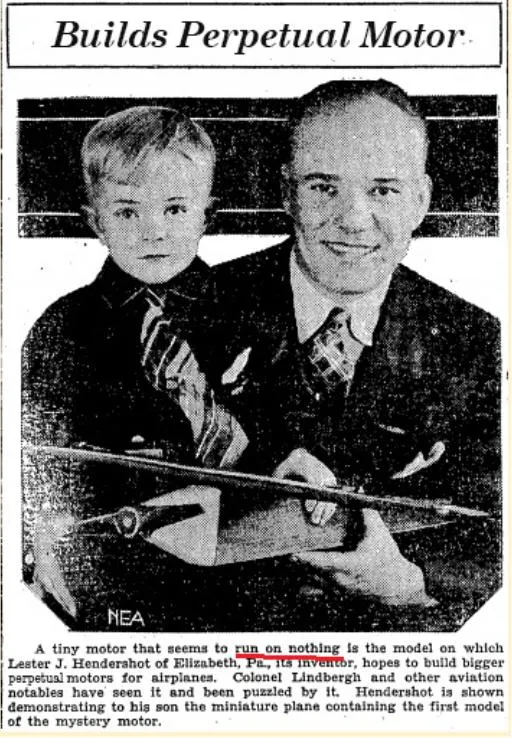
Lester J. Hendershot with his fuelless generator motor demonstration in 1928

Lester J. Hendershot demonstrates the fuel-less motor to his son, 1928

Fuelless Generator at a Glance

InventorLester J. Hendershot (USA, 1920s)
PrincipleMagnetic induction / "Radio principle"
Fuel RequiredNone ✓
EmissionsZero ✓
Noise LevelNear-silent (no engine)
Build Cost~$74 - $150 (guide + parts)
Fuel Savings$500 - $1,500+ per year
Skill LevelBasic DIY / soldering
Guarantee60-day money-back on guide
Get the Fuelless Generator Guide

Quick Answer: How Does a Fuelless Generator Work?

A fuelless generator produces electricity without burning gasoline, diesel, or any combustible fuel. The Hendershot fuelless generator, first demonstrated in 1928, uses magnetic induction — the same principle behind all electric generators — but replaces the fuel-powered engine with permanent magnets and resonant electromagnetic circuits.

According to 1928 newspaper archives, inventor Lester Hendershot demonstrated a device that ran on what reporters called a "radio principle" — tuned circuits that allegedly captured and converted ambient electromagnetic energy into usable electrical power. The device reportedly sustained 1,800 RPM for 3,000 hours without refueling or recharging.

What Is a Fuelless Generator?

A fuelless generator is any device designed to produce electrical power without consuming combustible fuel such as gasoline, diesel, propane, or natural gas. The concept challenges the conventional understanding that all generators require an engine burning fuel to spin a turbine and create electricity through electromagnetic induction.

The Hendershot fuelless generator is based on designs from American inventor Lester J. Hendershot, who demonstrated his magnetic motor device in February 1928. Unlike conventional generators that rely on internal combustion engines, the Hendershot device uses permanent magnets, copper coils, and capacitors arranged to create continuous electromagnetic induction without fuel input.

Key characteristics that define a true fuelless generator:

No Fuel Input Required

Operates without gasoline, diesel, propane, or any combustible fuel source. Eliminates fuel storage, transportation, and refueling.

Zero Direct Emissions

No exhaust fumes, carbon monoxide, or greenhouse gases during operation. Safe for indoor use with proper electrical precautions.

Near-Silent Operation

No combustion engine means no engine noise. The only sound comes from minimal mechanical vibration and electrical hum.

Minimal Maintenance

No oil changes, spark plug replacements, carburetor cleaning, or engine tune-ups required ever.

The Hendershot Generator DIY guide teaches you how to build this type of no-fuel generator using commonly available components. The total build cost of approximately $74-$150 makes it one of the most affordable DIY energy projects available.

How Does the Hendershot Fuelless Generator Work?

The Hendershot fuelless generator operates on principles of electromagnetic induction — the same fundamental physics that makes every electric generator on Earth work. Here is how the process is described in the DIY blueprints:

Step 1: Magnetic Field Creation

Neodymium permanent magnets are arranged in a specific geometric configuration to create a strong, focused magnetic field. These magnets require no electricity to maintain their field — they are permanent magnets that retain their magnetic properties indefinitely.

Step 2: Electromagnetic Induction

Copper wire coils are positioned within the magnetic field. According to Faraday's Law of Electromagnetic Induction (1831), when a conductor (copper wire) moves through a magnetic field, or when a magnetic field changes around a conductor, an electrical voltage is induced in the wire. This is the exact principle used in power plants, car alternators, and bicycle dynamos.

Step 3: Resonant Circuit Tuning

Capacitors are connected to the coils to form LC circuits (inductor-capacitor combinations). These circuits can be "tuned" to resonate at specific frequencies, potentially amplifying the induced electrical signals — similar to how a radio tuner selects and amplifies specific radio frequencies.

Step 4: Rectification and Output

Diodes and bridge rectifiers convert the alternating current (AC) produced by the coils into direct current (DC) suitable for charging batteries or powering DC devices. Transformers adjust the voltage to usable levels.

Important distinction: The Hendershot Generator guide correctly teaches real electromagnetic principles including Faraday's Law, Lenz's Law, and Maxwell's Equations. These are verified, Nobel Prize-winning physics. However, the claim that these principles can produce net energy output without an energy input violates the First and Second Laws of Thermodynamics and is not supported by peer-reviewed science.
The 1928 "Radio Principle" Explained

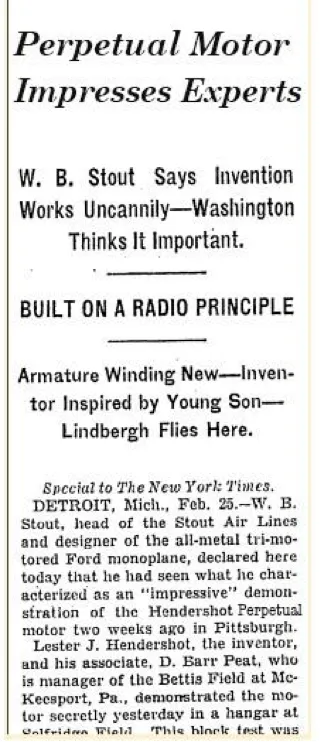
February 25, 1928 New York Times newspaper headline about Hendershot's perpetual motor impressing experts

New York Times, February 25, 1928: "Perpetual Motor Impresses Experts"

On February 25, 1928, The New York Times and dozens of other newspapers reported on Lester Hendershot's demonstration of a "fuel-less motor." The articles specifically noted that the device was "built on a radio principle."

But what did 1920s reporters mean by "radio principle"?

In the 1920s, radio technology was cutting-edge science. People understood that a radio receiver could capture invisible electromagnetic waves traveling through the air and convert them into audible sound — all without any visible power source. A crystal radio set, popular at the time, could receive broadcasts using only the energy of the radio waves themselves.

Hendershot's innovation, as described in period reports, was applying this same concept to electrical power generation. Instead of converting radio waves into sound, his device allegedly converted ambient electromagnetic energy into usable electrical current.

What the Newspapers Actually Reported:

  • The New York Times (Feb 25, 1928): Reported that aviation pioneer W.B. Stout called the demonstration "impressive" and "uncanny."
  • Military Verification: Major Thomas G. Lanphier at Selfridge Field confirmed the device had "enough power to kill a man."
  • Aviation Connection: Charles Lindbergh reportedly tested an electrified air engine powered by the Hendershot principle.
  • Documented Performance: Tests showed 1,800 RPM sustained for 3,000 hours — 125 days of continuous operation without fuel or recharging.
  • The Disappearance: By March 9, 1928, Hendershot was hospitalized after receiving 2,000 volts. He never spoke of his invention again.

Historical note: The 1928 newspaper coverage is authentic and verifiable. Whether the device performed exactly as claimed is a separate question from whether the coverage existed. The historical record is fascinating regardless of one's position on the physics.

Fuelless vs. Gas Generator Comparison

When considering a backup power solution, it is important to understand how fuelless generators compare to traditional gas generators across every important dimension:

Feature Hendershot Fuelless Gas Generator Diesel Generator
Fuel RequiredNoneGasolineDiesel
Fuel Cost (Annual)$0$500 - $1,500$400 - $1,200
EmissionsZeroCO, CO2, NOxHigh CO2, particulates
Noise LevelNear-silent65-85 dB70-90 dB
Indoor UseSafe (electrical only)Deadly CO riskDeadly CO risk
MaintenanceMinimalOil, plugs, filtersOil, filters, fuel system
Initial Cost~$74 - $150$300 - $2,000$500 - $5,000
Power OutputClaims disputedVerified kilowattsVerified kilowatts
Startup TimeInstantPull start / electricElectric start
Fuel StorageNot neededFlammable hazardFlammable hazard

Bottom line: Fuelless generators win on fuel costs, emissions, noise, maintenance, and safety. Gas generators win on verified power output and widespread availability. The Hendershot fuelless generator is best viewed as an educational DIY project and backup power experiment rather than a replacement for grid electricity.

Money Saved on Fuel — The Real Numbers

One of the most compelling arguments for a fuelless generator is the elimination of ongoing fuel costs. Here is a realistic breakdown of what Americans spend on generator fuel:

Typical Gas Generator Fuel Costs:

Usage ScenarioDaily Fuel CostAnnual Fuel Cost
Weekend camping (2 days/week)$15 - $30$780 - $1,560
Emergency backup (4 hrs/week)$5 - $10$260 - $520
Job site / work (8 hrs/day)$20 - $40$5,200 - $10,400
RV / off-grid living$10 - $25$1,825 - $4,563
Occasional power outages$10 - $20$100 - $300
Average homeowner$500 - $1,500

Fuelless Generator Savings:

Year 1 Savings

$500 - $1,500 in fuel costs eliminated, minus ~$150 build cost = $350 - $1,350 net savings

5-Year Savings

$2,500 - $7,500 in cumulative fuel savings with zero ongoing fuel expenses

Lifetime Savings

$10,000+ over 10+ years of operation with no fuel, oil, or maintenance costs

* Savings calculations assume the device performs as described in historical reports. Actual output may vary. No independent verification of over-unity operation exists.

Environmental Benefits of Fuelless Generation

A fuelless generator offers significant environmental advantages over fossil fuel-powered alternatives. Here is how the Hendershot fuelless generator compares from an ecological standpoint:

Zero Air Pollution

Gas generators emit carbon monoxide (CO), nitrogen oxides (NOx), hydrocarbons, and particulate matter. A fuelless generator produces none of these pollutants. No smog. No respiratory irritants. No contribution to ground-level ozone.

No Greenhouse Gas Emissions

Burning one gallon of gasoline releases approximately 19.6 pounds of CO2. A fuelless generator releases zero CO2 during operation, making it a carbon-neutral power source from an operational standpoint.

No Fuel Spill Risk

Gasoline and diesel spills contaminate soil and groundwater. Storage tanks can leak. Transporting fuel carries spill risks. A fuelless generator eliminates all fuel handling and storage hazards.

Reduced Noise Pollution

Gas generators produce 65-90 decibels of noise — comparable to a lawn mower or motorcycle. This noise disturbs wildlife, neighbors, and campsite peace. A fuelless generator operates near-silently.

Environmental verdict: From an operational perspective, a fuelless generator is dramatically cleaner than any combustion-based alternative. The only environmental consideration is the manufacturing footprint of the components (magnets, copper, capacitors), which is a one-time cost versus the continuous pollution of burning fuel.

Scientific Reality Check

As an editorial team committed to factual accuracy, we believe it is essential to present both the historical claims and the scientific context:

What Is Scientifically Verified:

  • Faraday's Law of Induction is real. Changing magnetic fields do induce electrical voltage. Every power plant, transformer, and electric motor relies on this principle.
  • The 1928 newspaper coverage is authentic. Multiple independent newspapers reported on Hendershot's demonstrations with specific details and named witnesses.
  • The components are real. Neodymium magnets, copper wire, and capacitors are standard electrical components that behave predictably.
  • The build is achievable. Users with basic DIY skills can construct the device as described in the blueprints.

What Remains Scientifically Disputed:

  • Over-unity operation. The claim that the device produces more energy output than input violates the Law of Conservation of Energy. No peer-reviewed study has ever demonstrated this.
  • Self-sustaining perpetual motion. All real-world electrical systems experience losses from resistance, heat, and friction. A device that sustains itself indefinitely with no energy input has never been scientifically validated.
  • The "radio principle" power source. While radio receivers do convert electromagnetic waves into electricity, the power available from ambient radio waves is measured in microwatts — far below household needs.

Our honest assessment: The Hendershot Generator is a fascinating historical project and an excellent educational tool for learning electromagnetism. It may produce small electrical outputs through legitimate magnetic induction. However, buyers should not expect it to power their homes or replace grid electricity. Approach energy claims with scientific skepticism and view the purchase as an educational DIY experience.

Frequently Asked Questions About Fuelless Generators

A fuelless generator is a device designed to produce electrical power without consuming gasoline, diesel, propane, or any other combustible fuel. The Hendershot fuelless generator is based on magnetic induction principles discovered in the 1920s by inventor Lester J. Hendershot. The device uses permanent magnets, copper coils, and capacitors arranged to create electromagnetic induction — the same principle that makes all electric generators work, but without requiring an external fuel source to spin a turbine.

According to 1928 newspaper reports, Lester Hendershot demonstrated a device that operated without gasoline or other fuel. The modern DIY guide teaches you to build a generator based on these historical designs using neodymium magnets and electromagnetic coils. However, claims of self-sustaining or over-unity operation are scientifically disputed by mainstream physics, which holds that energy cannot be created from nothing. The device may produce small electrical outputs through magnetic induction, but buyers should approach no-fuel claims with appropriate skepticism.

A typical gas generator consumes $10-$30 of fuel per day during continuous operation. Over a year of occasional use (weekends, emergencies), fuel costs can reach $500-$1,500. A fuelless generator eliminates these ongoing fuel expenses entirely. The Hendershot Generator DIY guide costs $29-$49.95 and parts cost approximately $45-$100, meaning the total investment of $74-$150 pays for itself in fuel savings within the first few months of regular use — if the device performs as claimed.

In February 1928, multiple newspapers reported that Lester Hendershot's device was "built on a radio principle." This referred to the use of tuned electromagnetic circuits — similar to how radio receivers capture and convert radio waves into electrical signals. Hendershot's design allegedly used resonant LC circuits (inductor-capacitor combinations) to capture and convert ambient electromagnetic energy into usable electrical power. While radio receivers do convert electromagnetic waves into electricity, the amount of power is typically minuscule compared to household energy needs.

Yes. Gas and diesel generators produce carbon monoxide, nitrogen oxides, particulate matter, and carbon dioxide emissions. A fuelless generator produces zero direct emissions during operation, making it significantly cleaner from an air quality standpoint. There are no exhaust fumes, no noise pollution from engine combustion, and no risk of fuel spills contaminating soil or groundwater. However, the environmental impact of manufacturing the components (magnets, copper wire, capacitors) should also be considered.

The Hendershot fuelless generator differs from gas generators in several key ways: (1) Fuel — Hendershot uses no fuel; gas generators require gasoline or diesel. (2) Emissions — Hendershot produces zero emissions; gas generators emit CO2, CO, and NOx. (3) Noise — Hendershot has no combustion engine noise; gas generators are loud. (4) Maintenance — Hendershot has no oil changes or spark plugs; gas generators need regular maintenance. (5) Cost — Hendershot costs ~$74-$150 total; gas generators cost $300-$2,000 plus ongoing fuel. (6) Power output — Gas generators produce verified kilowatts; Hendershot output claims are disputed.

The Hendershot Generator guide correctly references several established electromagnetic principles: Faraday's Law of Electromagnetic Induction (1831), which states that a changing magnetic field induces voltage in a conductor; Lenz's Law (1834), describing the direction of induced current; Maxwell's Equations (1860s), the foundational equations of electromagnetism; and LC Circuit Resonance, the interaction between inductors and capacitors. These are real, verified scientific principles. However, the claim that these principles can produce net energy output without an energy input violates the First and Second Laws of Thermodynamics.

Yes. The Hendershot Generator DIY guide provides step-by-step blueprints, video tutorials, and a complete parts list. Most builders with basic DIY skills can complete the project over a weekend. Required skills include basic soldering, wire cutting, and drilling. Parts cost approximately $45-$100 and include neodymium magnets, copper magnet wire, capacitors, and basic electrical components. The guide is delivered as an instant digital download with a 60-day money-back guarantee.

Unlike gas generators, which produce deadly carbon monoxide and must never be used indoors, a fuelless generator has no combustion and therefore no carbon monoxide risk. However, any homemade electrical device carries risks of electrical shock, short circuits, and fire. The Hendershot Generator has no UL listing or safety certification. Always follow electrical safety practices: use proper insulation, keep away from moisture, install fuses or circuit breakers, and never connect to household wiring without licensed electrician oversight.

After extensive newspaper coverage in February 1928 — including verification by aviation pioneer W.B. Stout and military testing by Major Thomas G. Lanphier — Lester Hendershot was hospitalized on March 9, 1928. Newspaper reports stated he had received 2,000 volts of electricity during an "experiment." He told doctors he was "just an electrician" and made no reference to his invention. After this incident, Hendershot vanished from newspaper coverage entirely. The device was never commercialized, and the original blueprints were lost to history. Modern researchers have reconstructed the design from period reports and patent filings.

Get the Hendershot Fuelless Generator Plans Today

Build Your Own Fuelless Generator

Complete DIY guide with blueprints, video tutorials, and parts list. No fuel. No emissions. No ongoing costs.

PDF Blueprints

Video Tutorials

Parts List

Regular Price: $49.95

$29.00

Limited Time Discount

Get Fuelless Generator Guide

60-day money-back guarantee — Instant digital delivery

About This Article

Author: Hendershot Generator Editorial Team

Editorially Reviewed by: David Chen, Electrical Engineering Consultant — 15+ years experience in power systems and electromagnetic applications.

This article was researched using historical newspaper archives, electromagnetic physics literature, and the Hendershot Generator DIY guide materials. We are committed to providing factual, evidence-based information about alternative energy technologies. This page contains affiliate links — if you purchase through our links, we may receive compensation at no additional cost to you. Last updated May 2026.

Limited Time — Special Discount Available!

Get the Hendershot fuelless generator guide at the lowest price. 60-day money-back guarantee.