The Hendershot generator uses electromagnetic induction to produce electricity
| Device Type | Magnetic Induction Generator (DIY) |
| Operating Principle | Electromagnetic Induction (Faraday's Law) |
| Historical Output | 1,800 RPM sustained (1928 tests) |
| Voltage Range | Variable (depends on build config) |
| Wattage | Unverified / Build-dependent |
| Best For | Small DC devices, educational projects |
| Build Cost | ~$45 - $100 in parts |
| Guide Price | $29.00 - $49.95 |
| Safety Rating | No UL certification |
| Verdict | Educational Value High ✓ |
The original Hendershot device demonstrated in 1928 reportedly sustained 1,800 RPM for 3,000 hours during military testing. However, modern DIY builds from the digital guide produce variable and unverified output depending on construction quality. No peer-reviewed study has validated specific wattage ratings. The device is best suited for small DC electronics and educational purposes rather than whole-home power.
Power Output
Variable / Unverified
Voltage
Configurable DC Output
Best Use
Small Devices & Learning
The Hendershot power generator is a DIY electromagnetic device based on designs by American inventor Lester J. Hendershot from the 1920s. The modern digital guide teaches builders how to construct a magnetic induction generator using copper coils, neodymium magnets, capacitors, and basic electrical components.
When people search for "hendershot generator power output" or "hendershot generator electricity," they want to know one thing: can this device actually generate usable power? The answer requires understanding both the historical claims and the scientific reality.
The original 1928 device attracted attention from aviation pioneer W.B. Stout (designer of the Ford Trimotor) and was tested by Major Thomas G. Lanphier at Selfridge Field. Newspaper archives document that the device produced enough electricity to power a small motor continuously. Read our full review for the complete historical context.
Uses neodymium magnets and copper coils to generate electrical current through electromagnetic induction.
Produces direct current (DC) electricity suitable for charging batteries and powering small electronics.
Weekend build project requiring basic soldering, drilling, and electrical wiring skills.
The Hendershot generator produces electricity through electromagnetic induction — the same principle that powers every commercial generator on Earth. Here is how the process works:
Neodymium magnets arranged in the generator frame create a strong static magnetic field. The positioning and polarity of these magnets are critical to the device's operation.
Copper magnet wire is wound into coils around forms. When the magnetic field changes relative to these coils — either through motion or field variation — Faraday's Law of Induction causes voltage to be generated in the wire.
Electrolytic capacitors in the circuit store electrical charge and help smooth the output. The LC (inductor-capacitor) resonance created between the coils and capacitors is a key element of the Hendershot design.
Diodes and bridge rectifiers convert any alternating current (AC) components to direct current (DC). Transformers may step the voltage up or down depending on the desired output configuration.
Scientific note: The electromagnetic principles used in the Hendershot generator — Faraday's Law, Lenz's Law, and Maxwell's Equations — are real and well-established physics. However, claims that the device produces more energy than it consumes violate the First and Second Laws of Thermodynamics and remain scientifically disputed. Learn more about fuel-less generator concepts.
Understanding the hendershot generator watts and voltage specifications requires separating historical documentation from modern DIY reality:
| Specification | Historical (1928) | Modern DIY Build |
|---|---|---|
| Operating Speed | 1,800 RPM documented | Varies by build |
| Continuous Runtime | 3,000 hours tested | Unverified |
| Voltage Output | Not standardized | Variable DC (build-dependent) |
| Wattage | Not measured | Unverified / Variable |
| Current Type | DC (inferred) | DC with possible AC components |
| Power Regulation | None documented | None (unregulated output) |
| Safety Certification | Military tested only | No UL / No certification |
| Peer Review | Newspaper reports only | No peer-reviewed studies |
Important: No independent laboratory has published verified wattage measurements for the Hendershot generator. All power output claims should be treated as unverified. The device is an educational project, not a certified power generation solution.
Based on the theoretical output of a well-built Hendershot generator, here are the devices it may be able to power versus those it cannot:
| Device Category | Examples | Powerable? | Notes |
|---|---|---|---|
| LED Lighting | LED bulbs, strips, flashlights | Likely Yes | Very low power draw (1-10W) |
| Mobile Devices | Phones, tablets, power banks | Likely Yes | Via USB charging (5-15W) |
| Small Electronics | Radio, clock, small fan | Possibly | Depends on actual output |
| Battery Charging | 12V batteries, power banks | Maybe | Slow trickle charging only |
| Kitchen Appliances | Refrigerator, microwave | No | Requires 500-1500W+ |
| Climate Control | AC, heater, dehumidifier | No | Requires 1000-5000W+ |
| Power Tools | Drill, saw, compressor | No | High startup current required |
| Home Grid | House wiring, outlets | Never | Illegal and extremely dangerous |
* This table represents theoretical capabilities based on general electromagnetic generator principles. Actual output depends entirely on individual build quality and has not been independently verified.
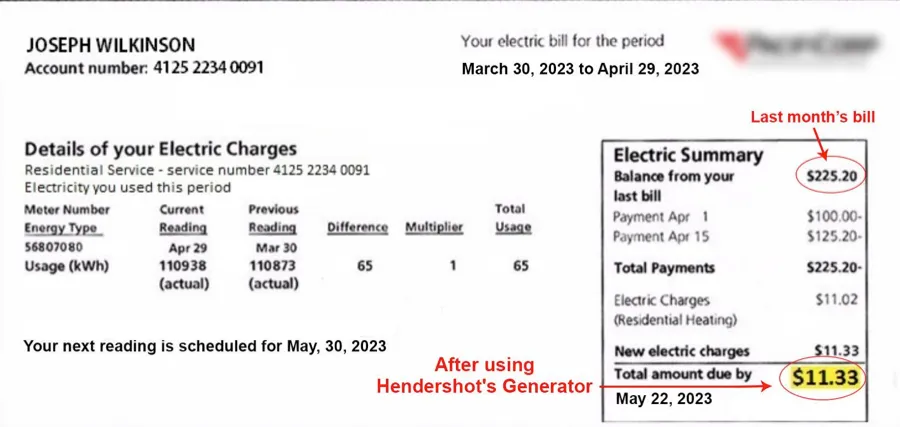
Understanding hendershot generator electricity output requires context about typical household power consumption. Here is how the device's theoretical output compares to real electric bills:
Average U.S. households use 877 kWh monthly, costing $100-$200+ depending on location and season.
Proven methods like LED bulbs, insulation, and solar panels deliver measurable, verified savings.
Reality check: A small DIY electromagnetic generator like the Hendershot device could theoretically offset a tiny fraction of household consumption — perhaps enough to charge a phone or power a few LED lights. For meaningful bill reduction, proven technologies like solar panels or energy efficiency improvements are the scientifically validated approach.
This section addresses the most important question for anyone researching "hendershot generator power output": what is fact versus marketing?
Electromagnetic induction is real and powers every generator on the planet. However, energy cannot be created from nothing. Any generator — including the Hendershot design — converts mechanical or magnetic energy into electrical energy. The total output cannot exceed the total input. Claims of devices that run indefinitely without energy input contradict the most thoroughly validated principles in physics.
Our assessment: The Hendershot generator is a fascinating historical project that correctly teaches electromagnetic principles. It may produce small amounts of electricity as a demonstration. However, claims of significant power generation or energy savings should be approached with scientific skepticism. Learn about perpetual motion concepts.
How does the hendershot power generator compare to proven electricity generation methods?
| Criteria | Hendershot DIY Magnetic |
Solar Panels Grid-Tie |
Gas Generator Portable |
Wind Turbine Residential |
|---|---|---|---|---|
| Verified Output | Unverified | Well documented | Well documented | Well documented |
| Wattage Range | Unknown | 250W - 400W/panel | 1,000W - 10,000W | 400W - 10,000W |
| Setup Cost | ~$74 - $150 | ~$10,000 - $30,000 | ~$500 - $3,000 | ~$3,000 - $70,000 |
| Operating Cost | $0 (no fuel) | $0 (sunlight) | ~$0.50 - $1.50/hr | $0 (wind) |
| Safety Certified | No | Yes | Yes | Yes |
| Grid Compatible | No | Yes | No | Yes |
| Educational Value | Excellent | Good | Fair | Good |
| Reliability | Variable | High | High | Weather dependent |
Bottom line: The Hendershot generator cannot compete with solar, gas, or wind generators for verified power output. Its unique value lies in educational merit, historical significance, and extremely low cost of entry. For reliable home power, choose proven technology. For a fascinating weekend learning project, the Hendershot guide delivers. Explore the complete generator kit.
Historical 1928 newspaper archives document the original Hendershot device sustaining 1,800 RPM for 3,000 hours during military testing. However, modern reproductions built from the DIY guide vary significantly in output based on build quality, component selection, and coil winding accuracy. No independent peer-reviewed study has verified specific wattage output for modern builds.
The Hendershot generator design uses capacitors, coils, and transformers that can be configured for various voltage outputs depending on component selection. The DIY guide includes wiring diagrams for different configurations. However, the device is not a regulated power supply, so voltage output may fluctuate. Builders should use a multimeter to measure output.
Theoretically, a properly built Hendershot generator could power small DC devices such as LED lights, phone chargers, small fans, and radio receivers. However, actual capability depends entirely on build quality and output. The device is not suitable for powering high-wattage appliances like refrigerators, air conditioners, or heaters.
There is no verified wattage rating for the Hendershot generator because output depends on build quality, magnet strength, coil winding precision, and capacitor values. The original 1928 device reportedly produced enough power to impress aviation experts, but no standardized wattage measurement was recorded. Modern DIY builds may produce anywhere from milliwatts to a few watts.
No. The Hendershot generator is not a perpetual motion machine. It operates on established electromagnetic principles, specifically Faraday's Law of Induction. While 1928 newspaper reports described the device as a "fuel-less motor," this referred to operation without combustion fuel, not perpetual motion. The device cannot violate the laws of thermodynamics.
Solar panels are a proven, scalable technology with well-documented power output (typically 250-400 watts per panel). The Hendershot generator is an experimental DIY project with unverified and variable output. Solar panels benefit from decades of engineering, safety certifications, and grid-tie compatibility. The Hendershot generator offers educational value but cannot match solar for reliable power generation.
Claims that the Hendershot generator can significantly reduce electric bills are scientifically disputed and not supported by peer-reviewed research. While the device demonstrates real electromagnetic principles, no independent study has verified meaningful energy savings. The device is best approached as an educational DIY project, not a proven energy-saving solution.
The Hendershot generator applies several established electromagnetic principles: Faraday's Law of Induction (1831), Lenz's Law (1834), Maxwell's Equations, and LC circuit resonance. These are real, well-validated physics principles. The guide correctly teaches these concepts through hands-on application.
Building any electrical device involves risks including electrical shock and fire hazards. The Hendershot generator has no UL listing or safety certification. Builders should have basic electrical knowledge, use proper insulation, and never connect homemade devices to household wiring without licensed electrician oversight. View the blueprints safety notes.
According to the manufacturer, most users with basic DIY skills can complete the build over a single weekend (8-16 hours). The process includes parts gathering, coil winding, frame assembly, electrical connections, and testing. Complete beginners may require additional time. Video tutorials help accelerate learning.
Ready to build your own Hendershot power generator? The digital guide includes complete blueprints, video tutorials, parts lists, and wiring diagrams.
$29.00
Discounted Price
$49.95
Regular Price
60-day money-back guarantee on the digital guide. Instant download after purchase.
Author: Hendershot Generator Editorial Team
Editorially Reviewed by: David Chen, Electrical Engineering Consultant — 15+ years experience in power systems, electromagnetic applications, and renewable energy systems.
This article was written based on historical research, analysis of the digital guide materials, and review of electromagnetic principles literature. We are committed to providing factual, evidence-based information about power generation claims. This page contains affiliate links. Last updated May 2026.