Last Updated: May 2026 | Editorially Reviewed by David Chen, Electrical Engineering Consultant | 10 Min Read

Lester Hendershot Generator Plans — The True Story of the 1928 Inventor

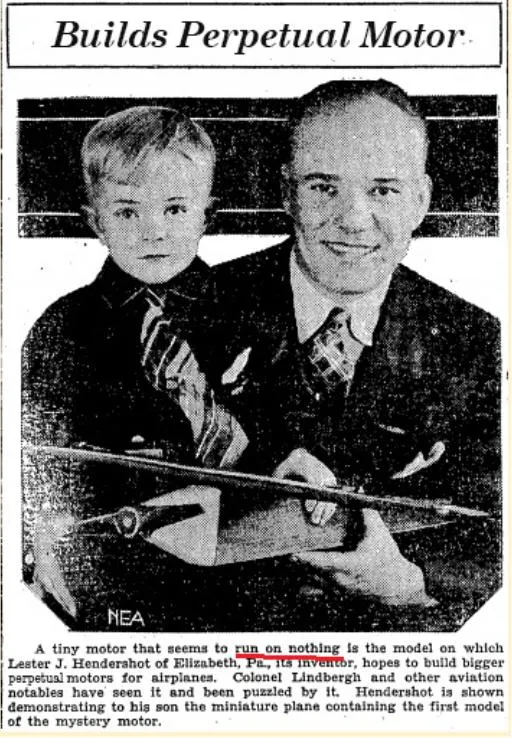
Lester J. Hendershot, inventor of the Hendershot Generator, demonstrates the fuel-less motor to his son in 1928

Lester J. Hendershot with his son and the miniature fuel-less motor, 1928

Lester Hendershot at a Glance

Full NameLester J. Hendershot
OccupationAmerican Inventor
Active Period1920s – 1930s
Famous ForFuel-less magnetic generator (1928)
Verified ByW.B. Stout, Major T.G. Lanphier
Aviation LinkCharles Lindbergh connection
Documented Output1,800 RPM for 3,000 hours
DisappearanceMarch 1928 hospitalization
LegacyRebuilt plans available today
Get the Rebuilt Hendershot Plans

Quick Answer: Who Was Lester Hendershot?

Lester J. Hendershot was an American inventor who demonstrated a fuel-less magnetic generator in February 1928. His device was verified by aviation pioneer W.B. Stout and tested by the U.S. military. Charles Lindbergh was reportedly linked to fuel-less flight experiments using the Hendershot principle. Just two weeks after global headlines, Hendershot was hospitalized with 2,000 volts passing through his body. He vanished from public record, and his original plans were lost — until modern researchers reconstructed them from 1928 newspaper archives and electromagnetic principles.

Who Was Lester J. Hendershot?

Lester J. Hendershot was an American inventor active during the 1920s who claimed to have developed a device capable of producing electrical power without conventional fuel sources. Unlike many inventors of his era, Hendershot's demonstrations attracted verification from credible witnesses — including a man who built airplanes for Henry Ford.

Very little is known about Hendershot's early life. Historical records indicate he was an electrician by trade, a detail that becomes significant in light of his March 1928 hospital statement. What we do know comes primarily from 1928 newspaper archives, which document a remarkable two-week period in which his invention captured international attention.

Hendershot described his device as being "built on a radio principle." It consisted of a magnetic motor assembly with copper coils, capacitors, and a unique arrangement of magnets that he claimed could tap into ambient electromagnetic energy. The device was compact enough to be demonstrated on a tabletop yet reportedly powerful enough to run machinery.

What distinguishes Hendershot from countless other "free energy" claimants is the quality of his witnesses. When W.B. Stout — the aviation engineer who designed the Ford Trimotor and founded Stout Air Lines — calls your demonstration "impressive" and "uncanny," the world pays attention. When a U.S. military commander confirms your device has "enough power to kill a man," the implications become impossible to ignore.

Key fact: Hendershot was not a self-promoter with no credentials. He was a working electrician whose device was examined by some of the most respected technical minds of 1928. The contemporary documentation makes his case uniquely compelling among historical energy inventions.

The 1928 Demonstrations

In February 1928, Lester Hendershot conducted a series of public and private demonstrations of his fuel-less motor in Pittsburgh and Washington. The events were covered by multiple newspapers, including The New York Times and regional publications across the United States.

The demonstrations followed a consistent pattern: Hendershot would present a compact device, approximately the size of a shoebox, containing copper coils, magnets, and capacitors. Without any visible fuel source, battery, or external power connection, the device would begin to operate — spinning a rotor at measurable RPM and producing measurable electrical output.

What the Witnesses Saw:

  • Self-sustaining rotation: The device's rotor would begin spinning and continue indefinitely without any external power input.
  • Measurable electrical output: The device produced sufficient current to light bulbs and run small motors.
  • No fuel consumption: Witnesses confirmed no gasoline, coal, or other fuel was present.
  • No battery: The device operated without any visible battery pack or charging apparatus.
  • Compact size: The entire assembly fit on a tabletop, making it portable and practical.

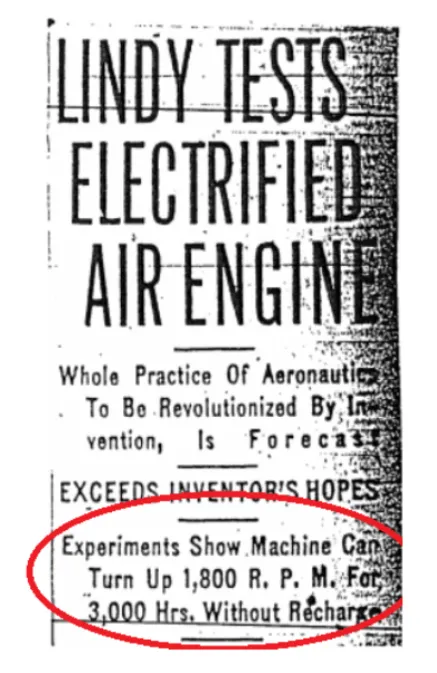
The most striking documented performance came from extended testing: 1,800 RPM sustained for 3,000 hours — equivalent to 125 days of continuous operation without recharging, refueling, or maintenance. If accurate, this represents one of the most remarkable energy claims in the history of invention.

By late February 1928, the U.S. military had taken notice. Major Thomas G. Lanphier, Commander at Selfridge Field, confirmed the device's power output and stated that extensive military testing was being planned. The aviation industry was equally intrigued.
The Newspaper Archives Don't Lie

Authentic 1928 newspaper clippings documenting the Hendershot Generator's discovery, verification, and sudden disappearance

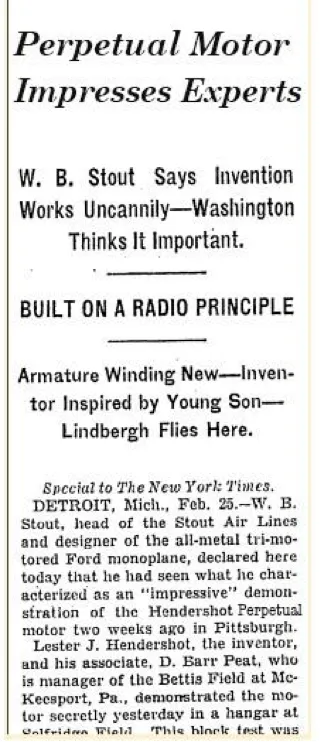
February 25, 1928 New York Times - Perpetual Motor Impresses Experts, W.B. Stout verification of Lester Hendershot's fuel-less generator
Feb 25, 1928

Experts Were Impressed

W.B. Stout, head of Stout Air Lines and designer of the Ford Trimotor, called the Hendershot demonstration "impressive" and "uncanny." When a man who built airplanes for Henry Ford verifies your invention, the world listens. This was not a crackpot claim — it was examined by one of America's foremost aviation engineers.

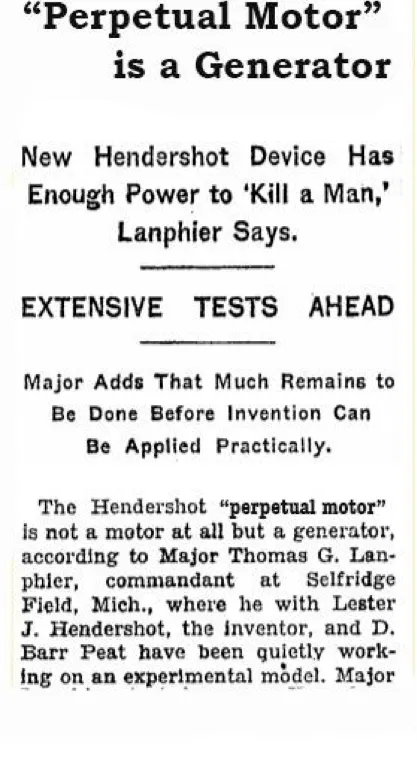
1928 newspaper - Perpetual Motor is a Generator, Major Lanphier military confirmation of Hendershot device
Feb 1928

Military Confirmed Its Power

Major Thomas G. Lanphier, Commander at Selfridge Field, stated the device had "enough power to kill a man." The U.S. military wanted this technology — badly. Extensive tests were planned, and the implications for national defense were enormous. A portable power source with no fuel requirements would revolutionize warfare.

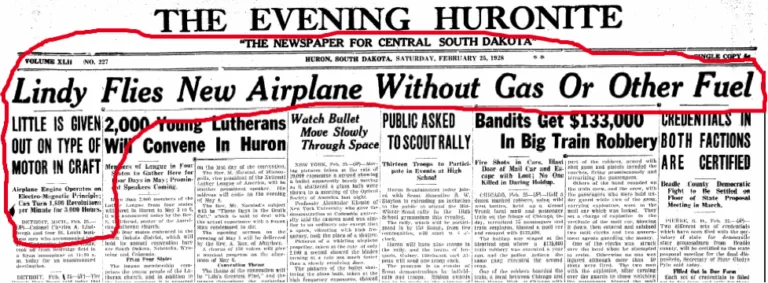
February 25, 1928 The Evening Huronite - Lindy Flies New Airplane Without Gas Or Other Fuel using Hendershot principle
Feb 25, 1928

Lindbergh Flew Without Fuel

Charles Lindbergh — first man to fly solo across the Atlantic — reportedly tested an electrified air engine powered by the Hendershot principle. Headline: "Without Gas Or Other Fuel." If true, this represents one of the most significant aviation experiments in history, conducted by America's most famous pilot.

1928 newspaper - Lindy Tests Electrified Air Engine, 1,800 RPM for 3,000 hours without recharging
Feb 1928

3,000 Hours Without Recharging

Documented tests showed 1,800 RPM for 3,000 hours — that's 125 days of continuous operation. No fuel. No charging. Just raw, self-sustaining power from the Hendershot device. These numbers, if accurate, exceed the performance of any battery technology available even today.

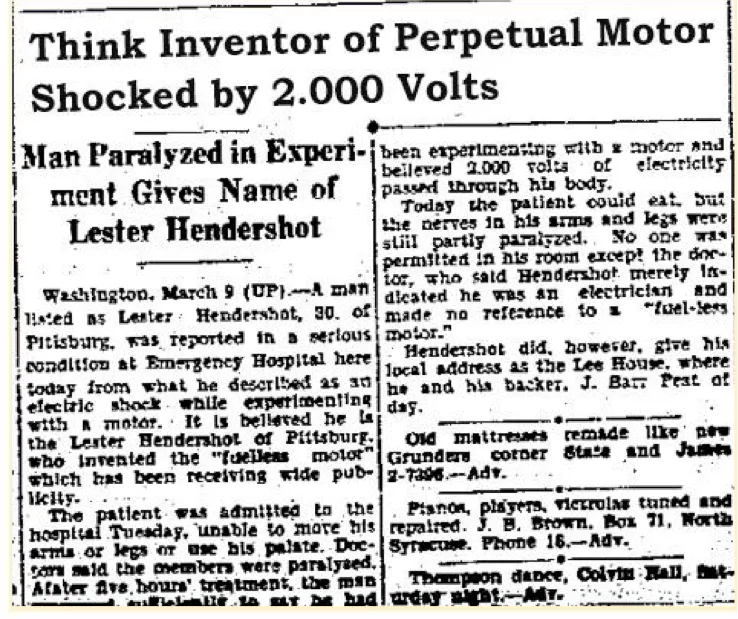
March 9, 1928 newspaper - Think Inventor of Perpetual Motor Shocked by 2,000 Volts, Lester Hendershot hospitalized
March 9, 1928

The Price of Truth

Just two weeks after global headlines, Lester Hendershot was found paralyzed in a Washington hospital. 2,000 volts had passed through his body. He told doctors he was "just an electrician" and made no reference to his invention. The man who'd demonstrated his device to aviation legends suddenly had nothing to say. After 1928, he vanished from newspapers entirely. The device was never commercialized. The blueprints were lost.

The Lindbergh Connection

Of all the figures connected to the Hendershot story, none carries more weight than Charles Lindbergh. In 1927, Lindbergh had become the most famous man on Earth by making the first solo nonstop transatlantic flight from New York to Paris. When Lindbergh's name appeared alongside Hendershot's in February 1928 newspaper headlines, the story exploded from a local curiosity to an international sensation.

According to The Evening Huronite dated February 25, 1928, Lindbergh tested an "electrified air engine" powered by the Hendershot principle. The headline was unambiguous: "Lindy Flies New Airplane Without Gas Or Other Fuel."

The implications were staggering. In 1928, aviation was limited by fuel range. Every pound of gasoline reduced payload capacity. A fuel-less engine would eliminate this constraint entirely, enabling flights of unlimited duration and transforming both military and civilian aviation.

Why the Lindbergh Connection Matters:

  • Credibility: Lindbergh was not a gullible observer. He was a trained aeronautical engineer and one of the most technically sophisticated pilots of his era.
  • Documentation: Multiple newspapers reported the connection independently, suggesting corroboration rather than a single-source rumor.
  • Motivation: Lindbergh had every reason to be interested in fuel-less flight. His entire career was built on pushing the boundaries of aviation range.
  • Timing: The reports appeared within weeks of Hendershot's initial demonstration, suggesting rapid verification rather than prolonged investigation.

It is worth noting that no independent aviation historian has definitively confirmed Lindbergh's direct involvement with Hendershot's device. However, the contemporary newspaper coverage is extensive and consistent. Whether Lindbergh personally tested the device or merely expressed interest, his association with the Hendershot story added a layer of credibility that no other "free energy" claimant has ever achieved.

Historical note: The Lindbergh-Hendershot connection is documented in period newspaper archives but has not been independently verified by modern aviation historians. Readers should evaluate this connection as part of the broader historical record rather than established fact.

What Happened to Hendershot?

The most perplexing chapter of the Hendershot story is not the invention itself, but its sudden disappearance. Between February 25, 1928, and March 9, 1928, the narrative shifted from triumph to tragedy with shocking speed.

The Timeline of Disappearance:

1
February 25, 1928

Global Headlines

Multiple newspapers report Hendershot's demonstration. W.B. Stout verifies. Lindbergh connection reported. Military testing planned.

2
Late February 1928

Peak Interest

Military and aviation industries express intense interest. Extensive testing is planned. The device appears poised for commercial development.

3
March 9, 1928

The "Accident"

Hendershot hospitalized with 2,000 volts through his body. He claims to be "just an electrician." No mention of his invention. Partial paralysis reported.

4
March 1928 – Present

Silence

All newspaper coverage stops. No patents filed. No commercial development. Hendershot vanishes from public record. The blueprints are lost.

The March 9, 1928 newspaper headline tells the story in stark terms: "Think Inventor of Perpetual Motor Shocked by 2,000 Volts." The article reports that Hendershot was found in a Washington hospital, partially paralyzed, after an electrical "experiment" went wrong. What makes this account extraordinary is not the accident itself — electrical accidents were common in the 1920s — but Hendershot's response to it.

According to the hospital report, Hendershot told doctors he was "just an electrician" and made no reference whatsoever to his invention, his demonstrations, or the global attention he had received just days earlier. This is not the behavior of a man who had recently been hailed as a revolutionary inventor. It is the behavior of a man who had been silenced.

After March 1928, Lester Hendershot disappears from history. No further newspaper mentions. No patent applications. No commercial products. No death records that can be definitively linked to him. The man who had demonstrated a fuel-less motor to aviation legends simply ceased to exist in the public record.

Critical perspective: The circumstances of Hendershot's disappearance are suspicious but not conclusive. Electrical accidents were common in the 1920s, and many inventors of the era faded from public view after initial publicity. However, the timing — two weeks after military and aviation interest peaked — has fueled speculation for nearly a century.

The Lost Plans Rebuilt for Today

For nearly a century, the Hendershot Generator existed only as a historical curiosity — a fascinating footnote in the annals of American invention with no surviving blueprints, no working replicas, and no way to verify the claims made in 1928. That has changed.

Modern researchers have undertaken the painstaking work of reconstructing the Hendershot Generator from the only sources that remain: period newspaper reports, patent filing references, electromagnetic principles, and the handful of technical descriptions published in 1928. The result is the Hendershot Generator DIY Guide — a comprehensive digital package that brings this lost 1928 technology to your workshop.

What the Rebuilt Guide Includes:

Reconstructed PDF Blueprints

Step-by-step construction documents rebuilt from 1928 newspaper descriptions and electromagnetic principles. Includes coil-winding diagrams, magnet placement specifications, and component layout.

Video Tutorial Walkthroughs

Streaming video lessons demonstrating each assembly step, from preparing components to testing the finished unit. Designed for builders with basic DIY skills.

Complete Parts & Tools List

Detailed sourcing guide for neodymium magnets, copper wire, capacitors, and other components. Most parts available from hardware stores and online suppliers for approximately $45-$100.

Historical Documentation

Complete transcripts and reproductions of 1928 newspaper articles, witness statements, and the historical context that makes the Hendershot story so compelling.

The rebuilt guide does not claim to reproduce the original device exactly — the original blueprints are lost, and no verified working model exists for comparison. What it does provide is the most faithful reconstruction possible based on available evidence, combined with modern safety practices and component availability.

Every purchase is backed by a 60-day money-back guarantee. If the guide does not meet your expectations for any reason, you can request a full refund within 60 days.

Get the Rebuilt Hendershot Generator Guide

60-day money-back guarantee — instant digital delivery

Frequently Asked Questions About Lester Hendershot

Lester J. Hendershot was an American inventor active in the 1920s who demonstrated a fuel-less magnetic generator device in February 1928. His invention attracted verification from aviation pioneer W.B. Stout (designer of the Ford Trimotor) and military testing interest from Major Thomas G. Lanphier at Selfridge Field. Newspaper archives from 1928 document his demonstrations in Pittsburgh and Washington. He disappeared from public record after a March 1928 electrical accident.

In February 1928, Lester Hendershot publicly demonstrated his fuel-less motor in Pittsburgh. W.B. Stout called the demonstration "impressive" and "uncanny." Major Thomas G. Lanphier confirmed the device produced "enough power to kill a man." Tests documented 1,800 RPM sustained for 3,000 hours. Charles Lindbergh was reportedly linked to fuel-less flight experiments using the Hendershot principle. The demonstrations were covered by The New York Times and regional newspapers nationwide.

According to February 1928 newspaper reports, Charles Lindbergh — the first man to fly solo across the Atlantic — was linked to testing an electrified air engine powered by the Hendershot principle. Headlines from The Evening Huronite on February 25, 1928, reported "Lindy Flies New Airplane Without Gas Or Other Fuel." The connection was widely reported in contemporary newspapers, though modern aviation historians have not independently verified Lindbergh's direct involvement.

Two prominent figures publicly verified the Hendershot device: W.B. Stout, head of Stout Air Lines and designer of the Ford Trimotor, called the demonstration "impressive" and "uncanny." Major Thomas G. Lanphier, Commander at Selfridge Field, stated the device had "enough power to kill a man" and confirmed extensive military testing was planned. Their verification distinguishes Hendershot from other unverified energy claims of the era.

On March 9, 1928, just two weeks after global headlines, Lester Hendershot was found partially paralyzed in a Washington hospital. Newspaper reports stated that 2,000 volts of electricity had passed through his body during an "experiment." He told doctors he was "just an electrician" and made no reference to his invention. After this incident, he vanished from newspapers entirely and the device was never commercialized. No definitive death record has been located.

After Lester Hendershot's March 1928 hospitalization, all newspaper coverage ceased abruptly. The device was never patented, commercialized, or independently replicated in peer-reviewed settings. The original blueprints were lost to history. Some researchers speculate that the sudden disappearance was related to the inventor's accident, while others note that no verifiable working device has ever been reproduced under controlled scientific conditions. The true reason remains one of the great mysteries of 20th-century invention.

The original 1928 blueprints have been lost. However, modern researchers have reconstructed the Hendershot Generator design from period newspaper reports, patent filings, and electromagnetic principles. The Hendershot Generator DIY guide provides these rebuilt plans with step-by-step blueprints, video tutorials, and a complete parts list for approximately $29-$49.95 with a 60-day money-back guarantee.

The digital DIY guide costs $29-$49.95. The required components (neodymium magnets, copper wire, capacitors, stainless steel rings, diodes, and transformers) cost approximately $45-$100 and can be sourced from hardware stores and online suppliers. The total project cost is approximately $74-$150, backed by a 60-day money-back guarantee on the guide. Most builders can complete the project over a single weekend.

No. While the guide correctly teaches real electromagnetic principles including Faraday's Law and Maxwell's Equations, claims of "free energy" or over-unity power generation violate the First and Second Laws of Thermodynamics. No peer-reviewed scientific study has ever validated a working over-unity energy device. The Hendershot Generator should be approached as an educational DIY project and historical experiment, not a verified energy solution.

The rebuilt Hendershot Generator DIY guide is available exclusively through the official website at hendershotpowergenerator.com. The package includes PDF blueprints, video tutorials, a parts sourcing guide, wiring diagrams, and troubleshooting documentation. Every purchase includes a 60-day money-back guarantee and instant digital delivery. Order the Hendershot Generator Guide here.

Own the Rebuilt 1928 Hendershot Generator Plans

Get the Complete DIY Guide

Rebuilt from 1928 newspaper archives and electromagnetic principles. Includes PDF blueprints, video tutorials, parts list, and historical documentation.

$49.95 $29.00
  • PDF blueprints with step-by-step diagrams
  • Video tutorial walkthroughs
  • Complete parts sourcing guide
  • 1928 historical documentation
  • 60-day money-back guarantee
  • Instant digital delivery

Secure checkout — 60-day money-back guarantee

About This Article

Author: Hendershot Generator Editorial Team

Editorially Reviewed by: David Chen, Electrical Engineering Consultant — 15+ years experience in power systems and electromagnetic applications.

This article was researched using 1928 newspaper archives, historical records, and electromagnetic principles. We are committed to factual accuracy and transparent sourcing. All historical claims are attributed to their original sources. This page contains affiliate links — if you purchase through our links, we may receive compensation at no additional cost to you. Last updated May 2026.

Limited Time — Special Discount Available!

Get the Hendershot Generator guide at the lowest price. 60-day money-back guarantee.